
PREV BLOG
Remote Work for Women: Building a Career, Income,…


Publish: April 09, 2026
Category: Business
There was a time when boardrooms were overwhelmingly dominated by men, and the idea of women leading the world’s largest corporations was more of an exception than the norm. But the landscape of global business has changed—and changed significantly.
Today, women are not only occupying the top seat but are also redefining what it means to lead. They are steering billion-dollar companies through uncertainty, driving innovation across industries, and making decisions that influence economies at a global scale.
What makes this moment even more powerful is that these women are not simply “filling positions.” They are transforming organizations, reshaping corporate culture, and proving that leadership is not defined by gender—but by vision, execution, and impact.
In 2026, the rise of women CEOs represents more than progress—it represents a shift in power, perspective, and performance.
Mary Barra’s journey to the top of General Motors is a story of consistency, deep industry knowledge, and bold decision-making. Having spent decades within GM, she understands the company from the inside out—a rare advantage in leadership.
What truly defines Barra’s leadership is her commitment to transformation. At a time when the automotive industry faces disruption from electric vehicles and sustainability demands, she has taken decisive steps to reposition GM as a future-focused company.
Under her leadership, GM has committed billions of dollars toward electric mobility, autonomous driving technology, and carbon neutrality. These are not just business moves—they are strategic shifts that will define the company’s relevance for decades.
Barra’s leadership style is calm yet decisive. She doesn’t chase headlines; she builds long-term value. And in a world driven by rapid change, that ability to stay focused while evolving makes her one of the most powerful CEOs globally.
When Jane Fraser became CEO of Citigroup, she didn’t just break a glass ceiling—she stepped into one of the most complex roles in global finance.
Leading a multinational bank with operations across continents requires more than financial expertise. It demands clarity, discipline, and the ability to simplify complexity. Fraser has focused on exactly that—streamlining Citi’s structure, exiting non-core markets, and strengthening its core business lines.
Her leadership is marked by precision. She is not interested in superficial growth; she is focused on sustainable, structured progress.
In a sector where every decision carries global implications, Fraser’s steady approach has helped Citigroup navigate regulatory pressures, economic shifts, and market volatility.
She represents a new kind of financial leader—one who combines analytical thinking with long-term strategic vision.
Julie Sweet leads one of the most influential consulting and technology firms in the world at a time when digital transformation is no longer optional—it is essential.
Accenture operates at the intersection of business strategy and technology, helping companies adapt to a rapidly changing environment. Sweet has embraced this role fully, positioning Accenture as a leader in cloud computing, artificial intelligence, and enterprise innovation.
What sets her apart is her ability to understand both technology and people. She recognizes that transformation is not just about systems—it’s about mindset, culture, and execution.
Under her leadership, Accenture has continued to grow while maintaining its reputation as a trusted advisor to global enterprises.
Sweet’s leadership reflects the future of business—where innovation, adaptability, and human understanding come together.
Safra Catz is often described as one of the most financially astute leaders in the technology industry. As CEO of Oracle, she has played a crucial role in steering the company through its transition from traditional software to cloud-based services.
Her strength lies in execution. While others focus on vision, Catz ensures that strategy translates into measurable results.
Oracle’s continued relevance in a highly competitive tech landscape is a testament to her disciplined leadership. She has maintained profitability, managed large-scale acquisitions, and ensured that the company evolves without losing its core strengths.
Catz’s approach proves that leadership is not just about bold ideas—it is about delivering consistent performance.
Rosalind Brewer’s leadership journey stands out not only for her achievements but also for the impact she is creating.
At Walgreens Boots Alliance, she is driving a transformation that goes beyond retail—toward healthcare services and patient accessibility. Her vision is to make healthcare more integrated, more accessible, and more efficient.
Brewer leads with empathy and purpose. She understands that businesses today must balance profitability with responsibility.
Her leadership is especially significant because it challenges traditional norms, proving that diversity in leadership brings fresh perspectives and better decision-making.
Emma Walmsley leads GSK in one of the most demanding industries—pharmaceuticals and healthcare.
Her tenure has been defined by focus. She has streamlined the company’s operations, sharpened its research priorities, and positioned it for long-term growth.
Walmsley’s leadership is not about rapid expansion; it is about making the right choices. In an industry where precision matters more than speed, her disciplined approach has proven effective.
She represents a form of leadership that values clarity, structure, and long-term impact.
Gail Boudreaux is redefining what healthcare leadership looks like in the modern era.
Under her leadership, Elevance Health has moved beyond traditional insurance models toward a more integrated, technology-driven healthcare system.
She understands that the future of healthcare is not just about treatment—it is about prevention, accessibility, and experience.
Boudreaux’s ability to combine business strategy with human-centered care makes her one of the most impactful leaders in the healthcare sector.
Thasunda Brown Duckett brings a unique perspective to financial leadership—one that is deeply rooted in inclusion and accessibility.
At TIAA, she is focused on helping individuals build long-term financial security, particularly in retirement planning.
Her leadership goes beyond numbers. She is actively working to make financial systems more inclusive and understandable for everyday individuals.
Duckett represents a shift in finance—from exclusivity to empowerment.
Carol Tomé stepped into the leadership role at UPS during one of the most challenging periods for global supply chains.
Her focus on efficiency and profitability has helped the company navigate disruptions while maintaining strong performance.
Tomé is known for making tough decisions—streamlining operations, optimizing costs, and ensuring long-term sustainability.
Her leadership proves that resilience and discipline are key to navigating uncertainty.
Kathy Warden operates in one of the most complex and high-stakes industries—aerospace and defense.
Her leadership requires not only business acumen but also an understanding of global security dynamics and advanced technologies.
Under her guidance, Northrop Grumman continues to innovate in areas such as cybersecurity, defense systems, and space exploration.
Warden’s role highlights the expanding influence of women in industries that were once considered out of reach.
The women on this list share more than titles—they share qualities that define modern leadership:
The ability to think long-term in a short-term world
The courage to make difficult decisions
The discipline to execute consistently
The understanding that people drive performance
What we are witnessing today is not just an increase in representation—it is a shift in influence.
Women CEOs are no longer exceptions; they are becoming essential contributors to global economic growth.
Their leadership styles often bring:
Greater collaboration
Balanced decision-making
Strong organizational culture
These qualities are increasingly valuable in today’s complex business environment.
The rise of powerful women CEOs marks a turning point in global business. These leaders are not just participating in the system—they are reshaping it.
As more women step into leadership roles, the definition of success itself is evolving. It is becoming more inclusive, more balanced, and more sustainable.
The future of business is not just about growth—it is about impact. And these women are leading that change.





Not long ago, work had a fixed structure. It meant commuting, office hours, and rigid routines that rarely adapted to personal life. For ma…
Most businesses are not destroyed by bad ideas, weak demand, or lack of effort. They are destroyed by success that arrives faster than stru…
Career growth is often described as progress—moving upward, taking on more responsibility, achieving visible success. For many women,…
Around the world, women are increasingly redefining what small business ownership looks like. It is no longer limited to storefronts or tra…
Entrepreneurship is no longer a side narrative in women’s lives. Across industries and geographies, women are building businesses tha…
Leadership has never been a neutral space. It has been shaped by history, power structures, and long-standing social expectations. For wome…
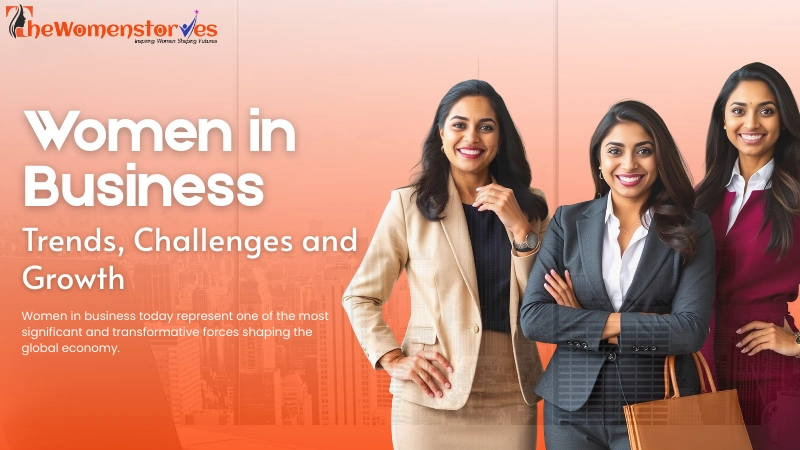
Women in business today represent one of the most significant and transformative forces shaping the global economy. Across regions, industr…

In the last decade, women have emerged as some of the most influential founders across industries, technology, finance, healthcare, fashion…

Freelancing has emerged as one of the most transformative career avenues for women in today’s digital economy. It offers flexibility,…

Working from home is not just a trend anymore, it has become a strong and practical way for women to build financial independence. Whether …