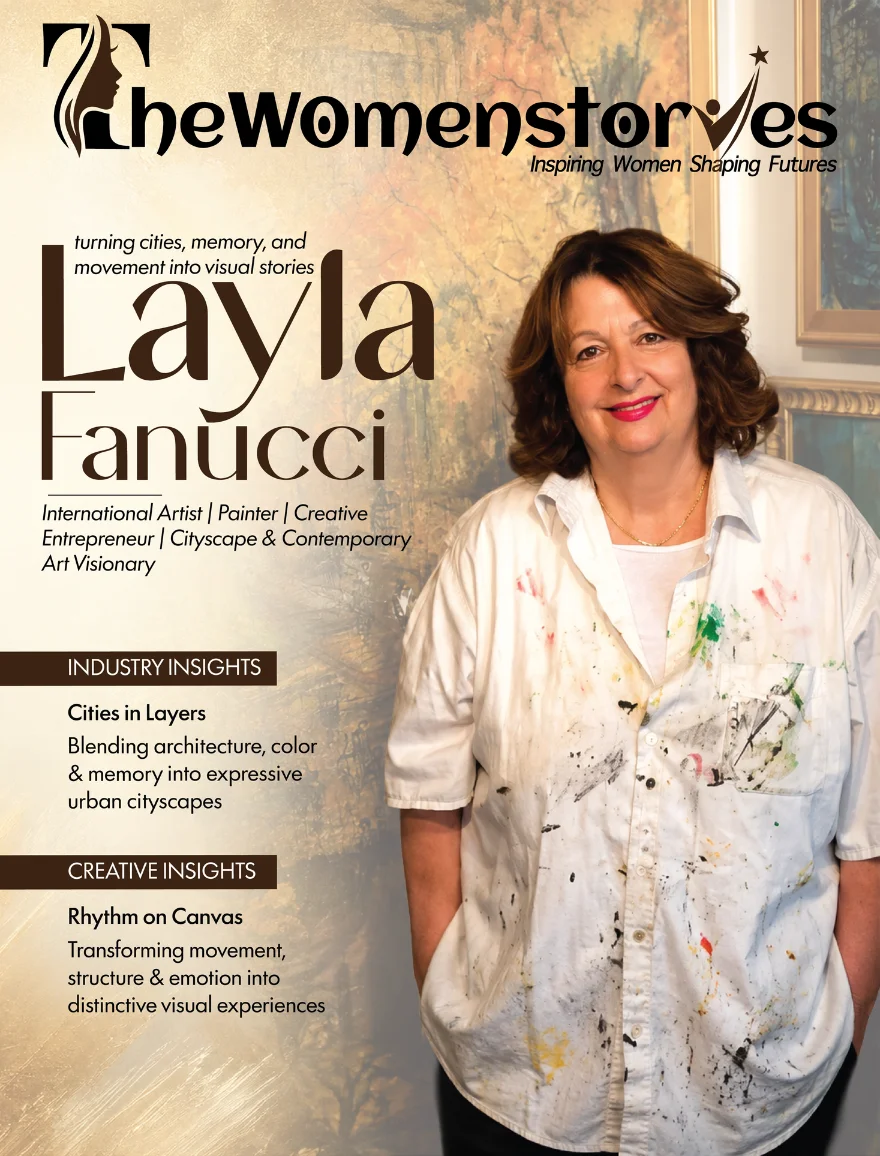
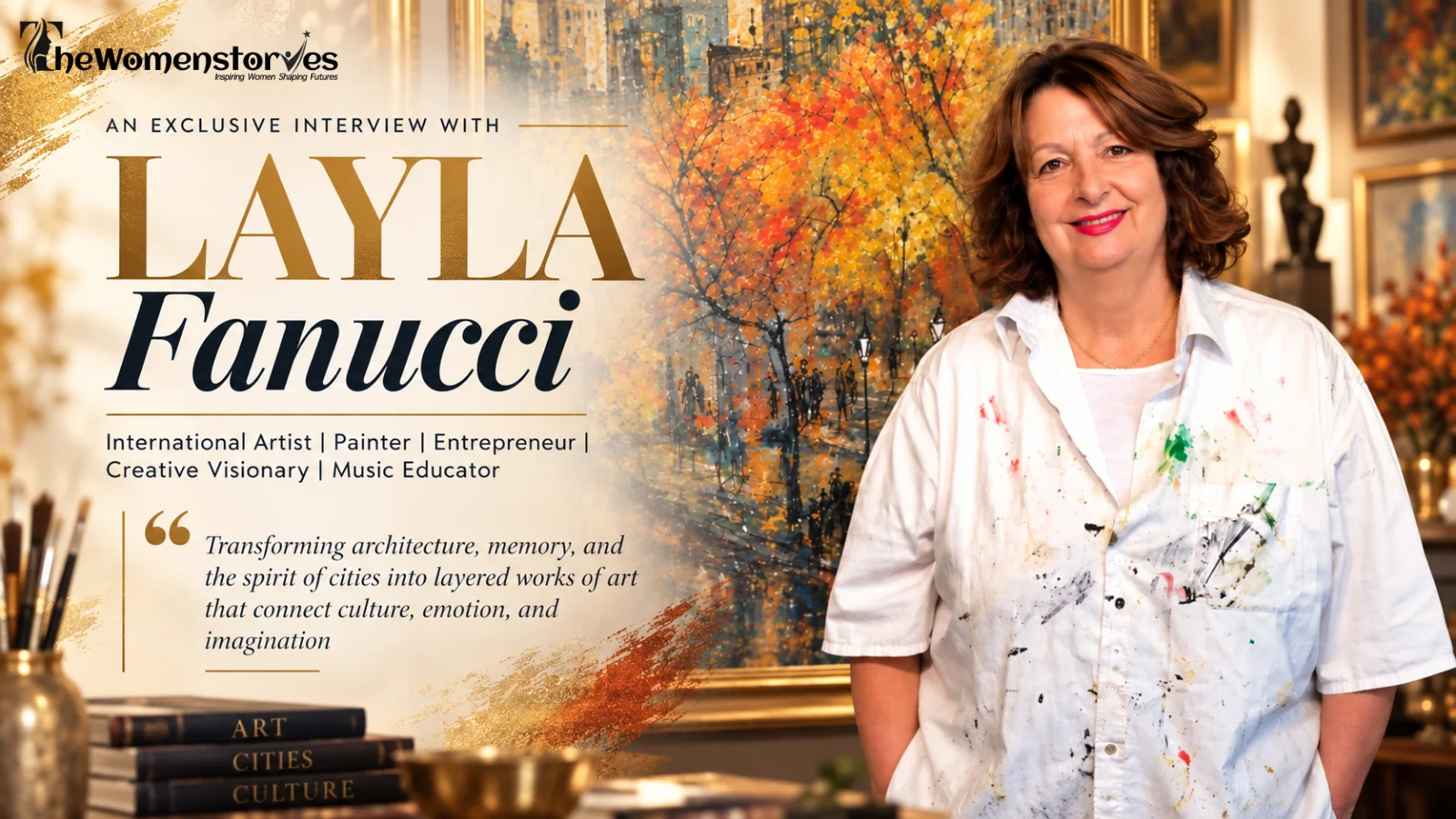
Some creative journeys begin with a carefully mapped destination. Others reveal themselves gradually, one expression at a time. For Layla Fanucci, the path from music educator to internationally exhibited painter emerged through curiosity, experimentation, and a willingness to follow creativity in an entirely new direction.
Long before cities became the defining subjects of her canvases, music shaped Layla’s understanding of rhythm, repetition, and expression. Her early years as a musician and educator, combined with the architectural influence of her father and the cultural and educational values encouraged by her mother, formed a foundation that would later find new meaning in her visual art. What began unexpectedly with a painting created for her own home eventually developed into a distinctive artistic practice centered on layered cityscapes, where architecture, color, memory, movement, and emotion intersect.
Today, Layla’s paintings have travelled far beyond her St. Helena studio, reaching exhibitions and private collections around the world. Yet her journey is about more than artistic recognition. It is also a story of creative reinvention, of leaving a long-established teaching career in her forties, developing an artistic language through self-directed study and experimentation, and building a life in which creativity became part of her everyday existence.
In this feature, Artist Layla Fanucci shares the experiences and influences behind that evolution, the connection between her musical background and painting process, her enduring fascination with urban environments, and what it means to live fully within a creative practice. Read on to discover the journey behind the layered cities that have become her distinctive artistic expression.
From Music and Family Influences to a Creative Life
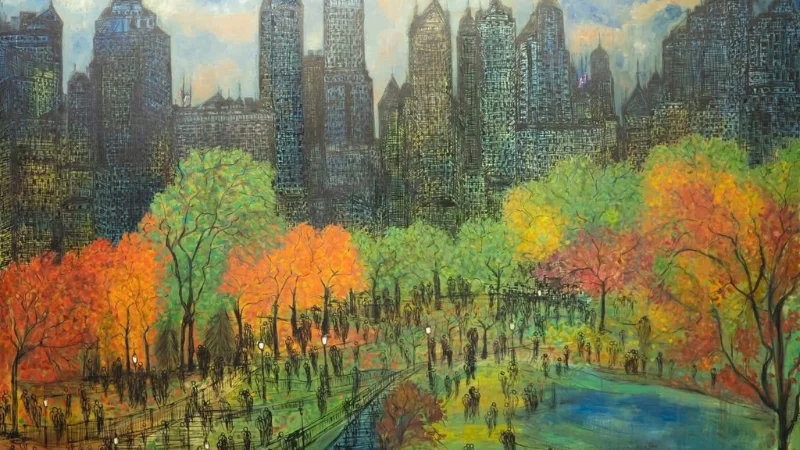
Layla Fanucci is an American painter known for her layered, architectonic cityscapes. She was raised in the hills of Atherton, California, in a home designed by her Turkish-born architect father, an early influence on her sensitivity to structure and form. Her French mother, an educator, fostered an appreciation for language, culture, and learning. Both of her parents immigrated to the United States in their twenties to study at the University of California, Berkeley.
Music was Fanucci’s first artistic discipline. She began studying piano at the age of five, later adding clarinet and guitar. As a teenager, she taught guitar and performed publicly at schools, churches, and community events. Recognizing that teaching would allow her to support herself, she pursued higher education while working as a music educator. She graduated from San Francisco State University in 1981 with a Bachelor of Arts degree in Sociology.
Layla met her husband, Robert Fanucci, through their church choir in Menlo Park. After their marriage, they lived in San Francisco before relocating in 1989 to St. Helena in Napa Valley, where Robert continued his family’s wine business, founded in the 1920s after his grandparents immigrated from Lucca, Italy. In Napa Valley, Layla taught choir, voice, and guitar in schools and churches, including St. Helena Catholic School, teaching music for twenty-five years.
An Unexpected Beginning in Painting
Her entry into painting began unexpectedly. Unable to find a painting for her home that resonated with her, she created one herself. Encouraged by the response from friends, she began painting seriously. In her forties, she left teaching to devote herself fully to art, developing her practice through sustained experimentation and self-directed study.
Seeking a distinctive visual language, Layla turned to cities, drawn to their architecture, history, and intensity. Early subjects included New York, London, Prague, and Paris, followed by Berlin, Istanbul, Rome, Venice, and others. Her process involves building dense layers of color before defining architectural forms in thin black lines, creating works that balance structure, movement, and emotional resonance.
Building an International Artistic Presence
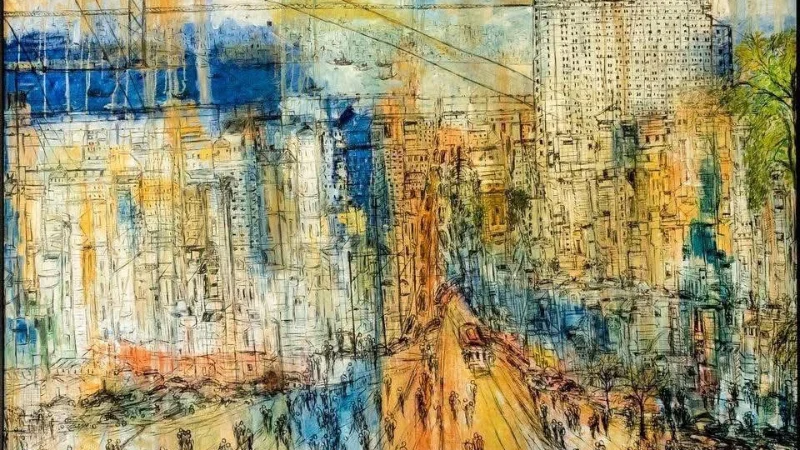
Since 2003, Fanucci has exhibited nationally and internationally, including at the Museum of Marrakech in Morocco. Her work is held in private collections worldwide. She is also co-owner of Charter Oak Winery and Art Studio in Napa Valley, where her paintings are displayed alongside the family’s winemaking tradition.
Media coverage of her work and life has included CNN, The Food Network, WBGO Radio, Martha Stewart Living, KRON 4, The Today Show, among others. With over 483 paintings sold, including works valued at up to $350,000, as well as countless giclées and prints, artist Layla Fanucci’s love letter to the urban metropolis is one that resonates with many.
The Walter Wickiser Gallery has published two books on Fanucci that explore her painting style in depth: Layla Fanucci – City of Dreams Unabridged: 1999–2011 and Layla Fanucci – Striking a Creative Note: Passion to Process.
In addition to being a well-known artist, Fanucci has also been recognized as a successful businesswoman. Her story was featured in Marlo Thomas’s book It Ain’t Over…Till It’s Over.
Cities as Memory, Movement, and Perception
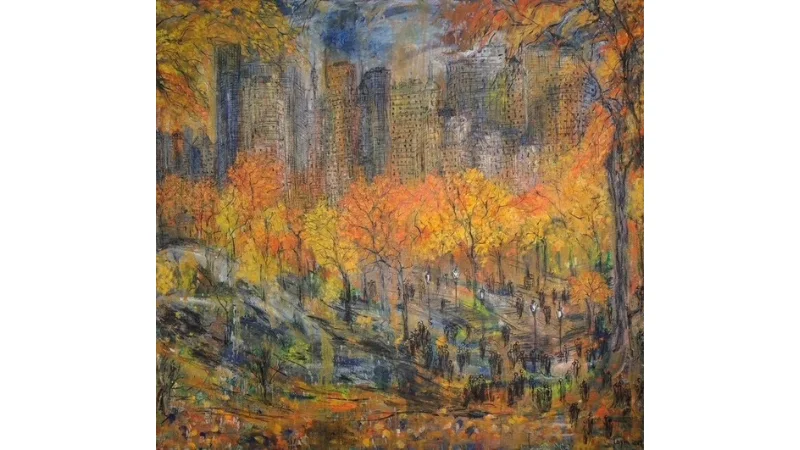
Fanucci’s work explores the city as a layered experience of memory, movement, and perception. She is drawn to urban environments for their density, complexity, and emotional charge, the way history, architecture, and human presence coexist within a single moment.
She builds each painting through a process of accumulation. Multiple cityscapes are layered atop one another, separated by fields of color and unified by black oil lines that articulate architectural form. These lines function both structurally and intuitively, allowing the city to emerge, dissolve, and reconfigure across the surface. The resulting compositions exist between abstraction and representation, where recognizable elements are present but never fixed.
Where Music Continues to Shape the Canvas
Her background in music continues to inform her approach to painting. She thinks of the surface rhythmically, in terms of repetition, variation, and tempo rather than narrative. Color establishes atmosphere and emotional register, while line creates tension, movement, and spatial negotiation.
Fanucci is less interested in depicting a specific place than in capturing the experience of being within a city, the simultaneity of past and present, the compression of time, and the sense of constant motion. For her, cities are not static forms but living structures shaped by memory, desire, and collective life. Each painting is an attempt to hold that complexity within a single, evolving field.
A Creative Practice Rooted in Everyday Life
Today, Fanucci continues to paint daily in her light-filled studio in St. Helena. While her work has achieved wide recognition, she considers her greatest accomplishment to be the ability to live fully within her creative practice, drawing inspiration from family, place, and the enduring vitality of the world around her.
Conclusion
For Layla Fanucci, creativity has never belonged to a single medium. Music gave her an early language of rhythm and expression, teaching introduced a life shaped by sharing and learning, and painting ultimately became the space where those influences could converge in an entirely new form. Her journey demonstrates how one creative chapter can quietly prepare the way for another, even when the destination is not yet visible.
That evolution continues to resonate throughout her work. In her layered cityscapes, architecture becomes more than structure, color carries atmosphere and emotion, and lines create a sense of rhythm and movement. Her cities are not simply representations of physical places; they reflect her fascination with memory, history, human presence, and the constant motion that gives urban life its distinctive energy.
Yet perhaps the most meaningful measure of Layla’s journey lies beyond exhibitions, collections, books, and recognition. It is found in the life she has created around her artistic practice, the opportunity to enter her St. Helena studio each day and continue exploring, experimenting, and responding to the world around her.
As Layla continues to paint, her work remains an evolving conversation between music and visual art, structure and spontaneity, place and memory. In every layered canvas, she continues a creative journey that began long before she became a painter and remains deeply connected to the family, experiences, and environments that have shaped the artist she is today.
More Features:-